

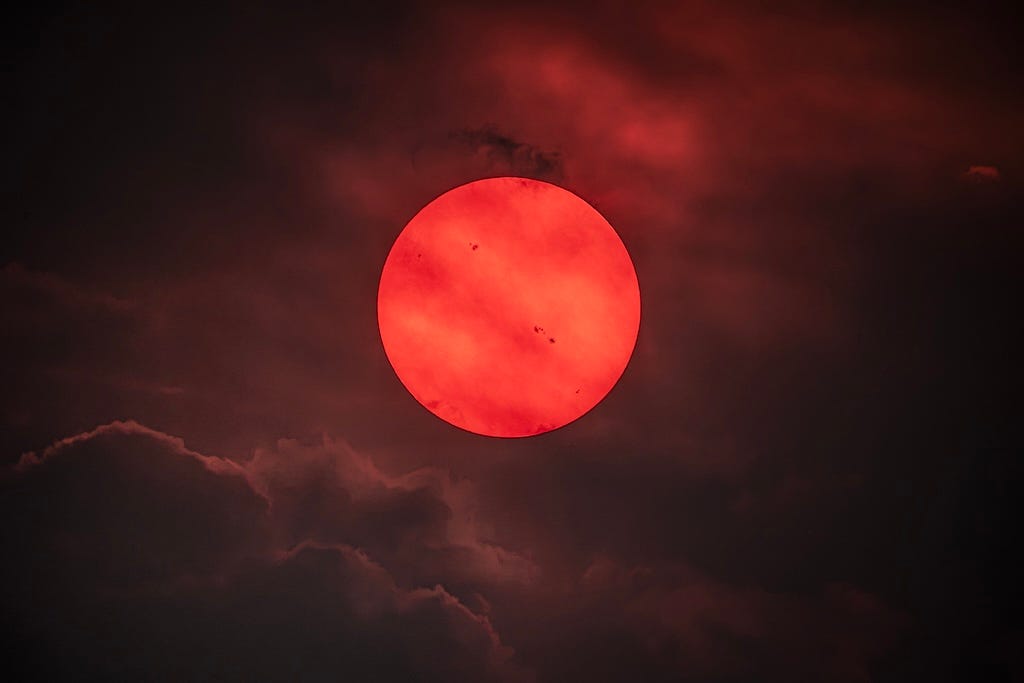
I have been SO busy the last several weeks; it's been a roller coaster. The summer nights have also been just so hot; the sky is not as clear as it is in the winter. So getting out to take pictures has been a bit scarce, but cooler nights are coming! Here is a quick overview of what’s happening this week.
This week the moon is on its way out of the picture, and that’s good news. It’s waning toward new phase, slipping past Mars in the pre-dawn sky on the mornings of August 8 and 9, then disappearing into the sun’s glare entirely by August 12. That’s no accident of timing; it means the sky will be at its darkest just as the Perseid meteor shower reaches its peak overnight on August 12–13, one of the best and most reliable showers of the year, with no moonlight to wash it out. Find an open patch of sky after midnight, give your eyes twenty minutes to adjust, and look up.
“When I look at your heavens, the work of your fingers, the moon and the stars, which you have set in place, what is man that you are mindful of him?” (Psalm 8:3–4, ESV).
Something is fitting about a meteor shower arriving in the dark; not the moon’s borrowed light, but tiny fragments of ancient comet dust burning up exactly on schedule, exactly where they were set to be, thousands of years before anyone thought to look up and wonder. The heavens keep their appointments whether we’re watching or not. This week, it’s worth watching.
Friday, August 7
The Moon passes 5° north of Uranus at 1 P.M. EDT. The pair is visible in the early-morning sky, along with a lunar occultation of the Pleiades just after moonrise. Check out the August 7 entry in last week’s Sky This Week column for more details.
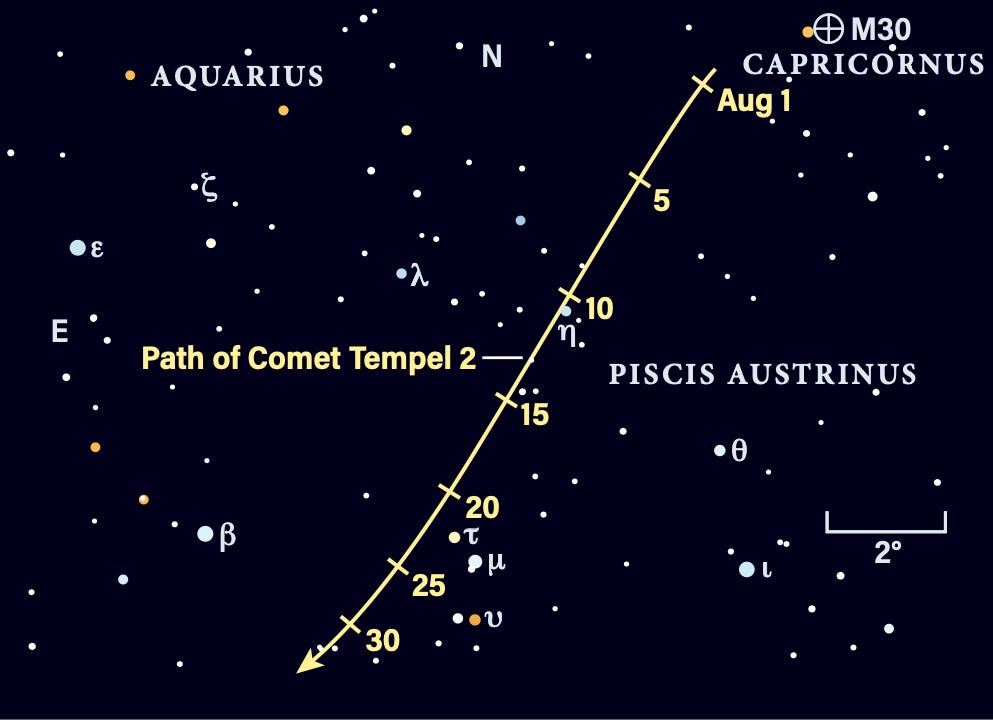
Late tonight, there’s a good hour of viewing time to try to catch Comet 10P/Tempel (also known as Tempel 2), which rises around 9:30 P.M. local daylight time and climbs above the most turbulent air at the horizon around midnight. By local midnight, Tempel 2 is some 18° high in the south, to the upper right of the bright star Fomalhaut in Piscis Austrinus and near that constellation’s border with Capricornus.
To find the comet, start by centering 1st-magnitude Fomalhaut in binoculars or, better yet, a telescope. From this star, move about 9.7° west-northwest to 5th-magnitude Lambda (λ) Piscis Austrini, then continue another 3.6° in the same direction along that same line to land on the comet’s location.
Until next time, keep looking up!
-g
That's the perfect birthday present for my son Jed- Aug 12!