

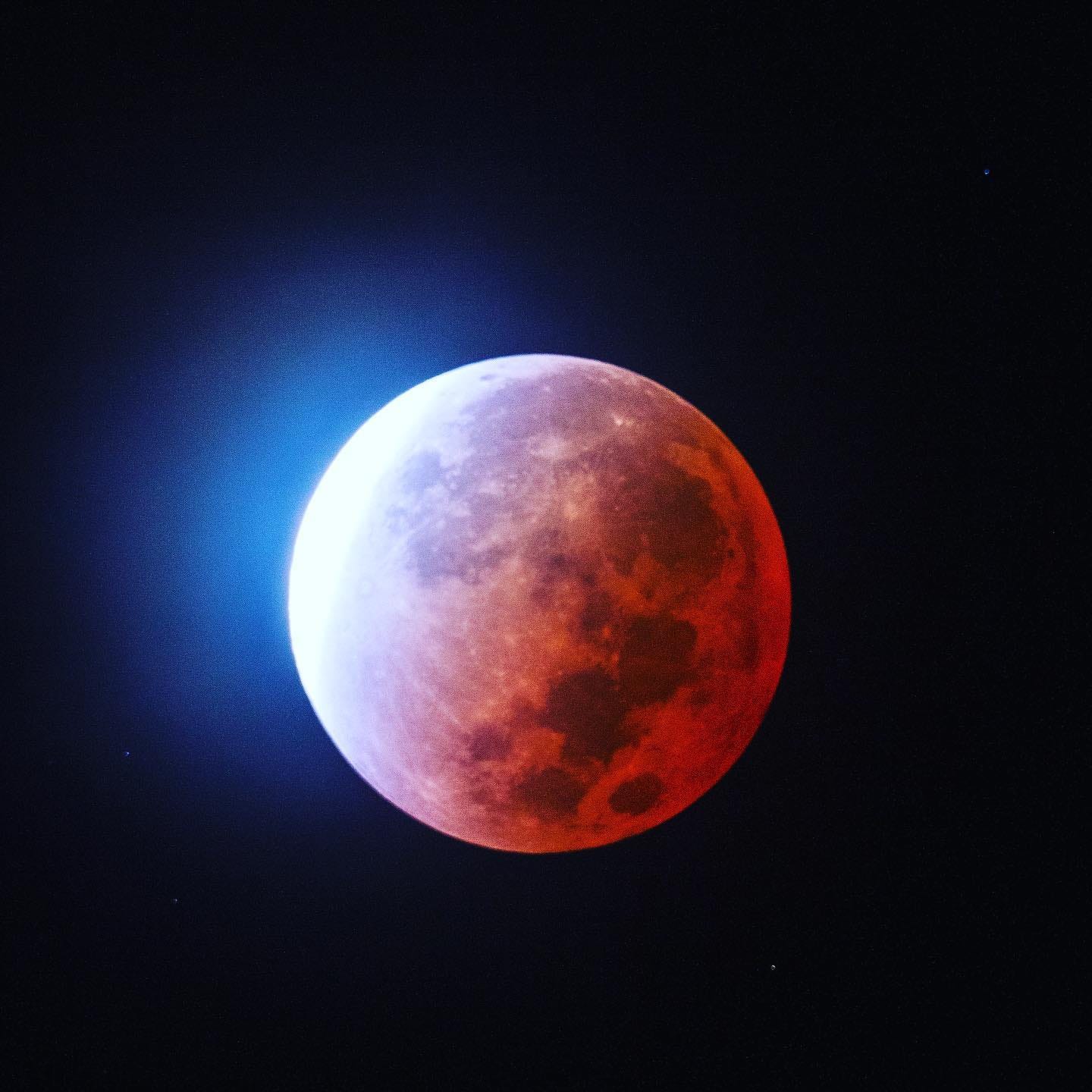
Tonight (Thursday/Friday) we have an almost full lunar eclipse, and as with any lunar eclipse, real beauty can unfold as the brightest object in the sky (the moon) slips into darkness.
This got me thinking of my own bright moments in life that then got tainted by darkness, like a slow progression of shadow that crept across all the good in my life (much like the shadow creeps across the surface of the moon during an eclipse), that darkness on the surface became all consuming causing me to fall into what I consider a breaking point in my life.
Is it by accident that the moon turns red during a lunar eclipse? We call this a Blood Moon. Yes I know the science behind how and why the atmosphere and light and all that creates this effect, but didn’t Jesus also die and shed his blood for our sins? Can we see the parallel here? Light, darkness, blood, light again. How incredible is that?
Do you know what else happens during a lunar eclipse? The stars come out, they shine bright, it’s incredible. When I think about the people in my life who shined their light on me in my darkest moment, I saw Christ in them as they pulled me from the grips of destruction, and as the moons light starts to wash away the red glow as the eclipse fades, it comes back into full glory, shining bright again for all to see.
That’s my hope, that’s me, I want to and will shine bright again, the darkness is not forever. I’m starting to feel and see the light around me in new friends, unexpected opportunities, new doors opening. Stronger relationships, deeper rooted growth It’s what having Faith is all about.
It’s a reminder of how small our light really is next to God’s.
“When I look at your heavens, the work of your fingers, the moon and the stars, which you have set in place, what is man that you are mindful of him?” (Psalm 8:3–4, ESV).
The same hands that hung the Moon in its place also know each of us by name.
Until next time, keep looking up!
-g
This week's headline event happens late Thursday night into Friday morning, August 27–28: a deep partial lunar eclipse, the best one anywhere on Earth until 2028. Just over 96% of the Moon will slide into our planet's shadow, leaving only a thin, glowing sliver of light along one edge. No glasses or equipment needed — just find an open view toward the moon and watch. Maximum eclipse falls around 12:12 a.m. EDT (9:12 p.m. PDT on the 27th), and if you're in the central or eastern U.S., the whole event unfolds high in a dark sky. Earlier in the week, look west just after sunset for brilliant Venus, and before dawn, Saturn hangs in the east with Jupiter following low behind it.